Mastering Facebook Book Ad Sizes in 2026: Your Essential Guide to Conversion-Ready Creatives
By Zachariah Stratford
Advertising your non-fiction book on Facebook can drive significant sales, but only if your ads look professional and perform optimally across various devices. The key to successful Facebook book ads in 2026 lies in understanding and adhering to the platform's specific size and technical requirements for static images. This guide breaks down everything you need to know to create compelling, conversion-ready visuals that capture your audience's attention.
Why Facebook Ad Specs Matter for Book Authors
Imagine investing valuable time and marketing budget into a Facebook ad campaign, only for your book cover to appear pixelated, cropped, or poorly formatted on a user's feed. This common pitfall can severely diminish your ad's effectiveness and waste your hard-earned money. Facebook's algorithms favor well-formatted content, and consistently adhering to their ad specifications ensures your static ads are displayed correctly, leading to higher engagement rates and better return on investment (ROI). Proper sizing prevents awkward cropping, maintains image quality, and ensures your critical book title and author name are always visible. Ultimately, it means your target readers see your book exactly as you intended, increasing the likelihood of a click-through and a purchase.
Essential Facebook Static Image Ad Sizes for Books in 2026
When designing static image ads for your book on Facebook, several key dimensions and ratios dominate to maximize visibility and impact. Focusing on these ensures your ad looks great across desktops, tablets, and mobile devices.
Square (1:1 Ratio) Image: This is arguably the most versatile and commonly used format for static ads. With a recommended resolution of 1080 x 1080 pixels, square images offer excellent visibility in the feed and perform well across most placements, including Instagram. This ratio provides ample space for your book cover and a concise, compelling headline.
Landscape (1.91:1 Ratio) Image: Ideal for link ads that direct users to your book's sales page, the landscape format has a recommended resolution of 1200 x 628 pixels. While slightly less prominent in mobile feeds compared to square images, it's still effective for showcasing wider imagery or a cover with a more horizontal orientation.
Vertical (4:5 Ratio) Image: Increasingly popular, especially for mobile-first audiences, vertical images with a recommended resolution of 1080 x 1350 pixels take up more screen real estate, increasing your ad's stopping power. This format is excellent for capturing attention as users scroll through their feeds.
Always prioritize high-resolution images to prevent pixelation, ideally 72 DPI or higher. File types should be JPG or PNG for optimal quality and faster loading times.
Facebook Book Ad Static Image Specifications Checklist for 2026
Image File Type: JPG or PNG (PNG is preferred for text clarity).
Image Ratio (Square): 1:1, Recommended Resolution: 1080 x 1080 pixels (minimum 600 x 600).
Image Ratio (Landscape): 1.91:1, Recommended Resolution: 1200 x 628 pixels (minimum 600 x 315).
Image Ratio (Vertical): 4:5, Recommended Resolution: 1080 x 1350 pixels (minimum 600 x 750).
Text in Image: Aim for less than 20% text overlay for optimal delivery, though Facebook no longer strictly penalizes ads with more text.
Image File Size: Maximum 30 MB.
Primary Text: Up to 125 characters (visible without clicking "See More").
Headline: Up to 40 characters for optimal display.
Description: Up to 30 characters for optimal display.
The Classic Split template — cover on one side, promise on the other
Crafting Compelling Copy for Your Book Ads
Beyond the visual, the text accompanying your Facebook ad is crucial for convincing readers to click. Your primary text, headline, and description each play a distinct role.
Primary Text: Hook and Problem
This is the main body of your ad. Start with a strong hook that resonates with your target reader's pain points, clearly established during your book's ideation. Aim for around 125 characters to be fully visible before Facebook truncates it with a "See More" link. Use this space to introduce your book's core value proposition and how it addresses a specific challenge or desire your audience has. For example, instead of "My new book," try "Feeling stuck on your career path? My latest book reveals the 3 strategies top performers use to skyrocket their success."
Headline: The Promise
The headline sits directly below your image and should deliver a clear promise or benefit. Keep it concise, ideally under 40 characters, to prevent it from being cut off. This is where you can reiterate your book's impact. A powerful headline might be "Unlock Your Inner Leader Today" or "Master Time Management in 7 Days."
The Stat Scoreboard template — numbers carrying the creative
Description: The Call to Action (CTA)
The description appears below the headline and provides a secondary, often subtle, call to action. While shorter (up to 30 characters), it's an opportunity to reinforce urgency or a specific benefit. Examples include "Download Your Copy Now" or "Limited-Time Offer."
Common Mistakes to Avoid in Facebook Book Ads
Even with the right sizes, several pitfalls can undermine your ad's performance. First, avoid low-resolution images. A blurry cover signals unprofessionalism. Second, don't neglect mobile optimization. Over 90% of Facebook users access the platform on mobile, so always preview your ads on different devices. Third, be mindful of the "20% text rule." While Facebook no longer strictly enforces it, ads with less text overlay on the image itself often perform better as they look less "salesy" and more organic. Finally, ensure your call to action (CTA) is clear and compelling. "Learn More" is standard, but consider more direct options like "Shop Now" or "Get Your Copy" if applicable.
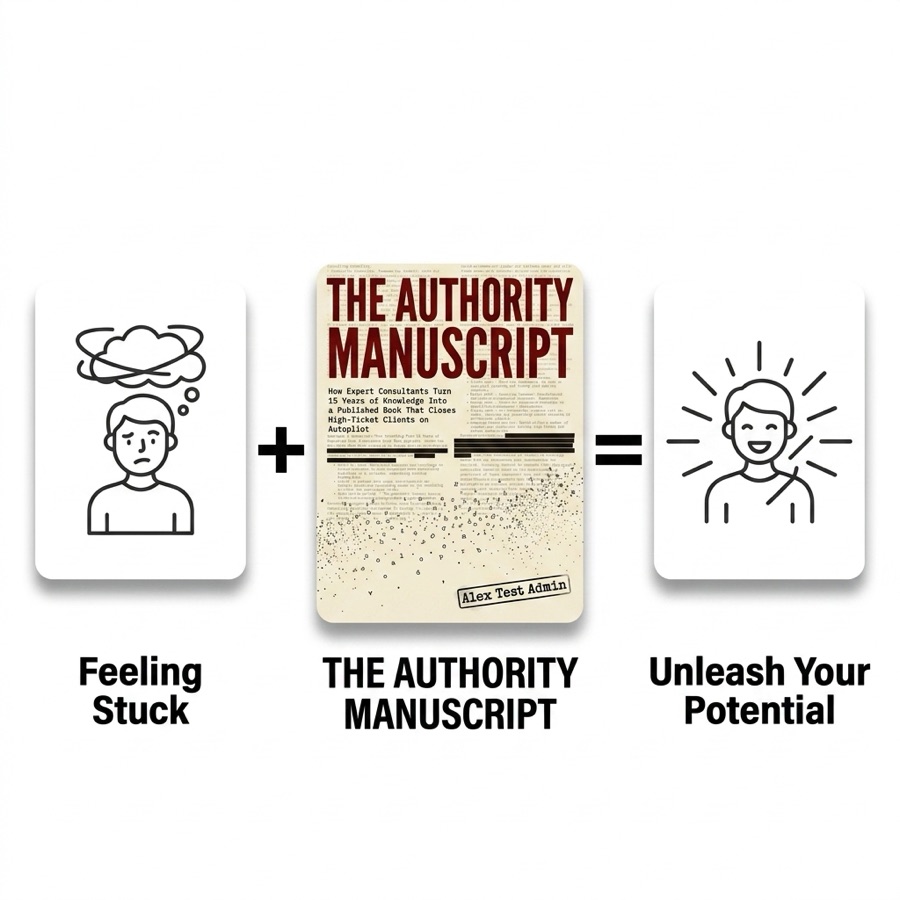
The Book Math template — the argument laid out as an equation
Designing Your Static Ads with AuthorWizard.app
Creating eye-catching, spec-compliant static ads for your book doesn't have to be a graphic designer's nightmare. AuthorWizard.app offers powerful tools to simplify the process, ensuring your ads look professional and adhere to Facebook's requirements without you needing to manually resize or guess pixel dimensions.
The platform streamlines the entire process, starting with the foundational elements of your book's marketing. During Stage 2, The Strategy Brief, AuthorWizard analyzes your book against 24 months of real New York Times Bestseller List data, identifying the 3 closest comparable books. This market intelligence informs not only your book's positioning but also provides insights into what visually resonates with your target audience, directly influencing your ad creative choices. You also receive 7 real KDP search keywords and specific reader communities to target at launch, ensuring your ads reach the right people.
When it comes to the visual assets for your static ads, AuthorWizard’s Stage 3, 3 Cover Concepts, generates three distinct AI-powered cover designs, each with unique visual styles, color palettes, and typography. Once you select your favorite, Stage 4, The Cover Designer, takes it to the next level. This tool pulls up to 6 real bestselling covers in your category and, using AI vision, analyzes their color psychology, typography, composition, and mood, then provides you with a written recommendation and 3 suggested palettes. This ensures your book cover is not only beautiful but also competitively positioned and optimized for visual impact—a critical component for any static ad. The Cover Designer exports Amazon-ready covers at 300 DPI resolution with 0.125-inch bleed on all sides, ensuring your cover image is pristine for use in ads.
Finally, in Stage 13, Static Ad Generation, AuthorWizard empowers you to create stunning ad creatives directly. You can generate a batch of 10 AI-written ad concepts, complete with headline, visual (using your own book cover), platform suggestions (Instagram/Facebook/LinkedIn/TikTok), and body copy, all in one pass. Alternatively, choose from 15 individually designed ad templates like "Movie Poster," "Billboard Takeover," or "The Receipt" to craft a single, high-impact ad. If you've found a competitor's ad you admire, you can even recreate it using your own book cover, allowing you to quickly adapt proven strategies to your own marketing efforts. This seamless integration ensures your static ads are always perfectly sized, visually appealing, and strategically aligned with your book's market.
Testing and Optimizing Your Facebook Ads
The work doesn't stop once your ad is live. Facebook's Ad Manager provides robust analytics that are crucial for understanding what's working and what isn't. Monitor key metrics such as click-through rate (CTR), cost per click (CPC), and conversions (book sales). A/B test different ad creatives, headlines, and primary texts to see which combinations perform best. For example, test a square image against a vertical one, or two different headlines for the same visual. Even small tweaks, like changing a single word in your primary text, can lead to significant improvements over time. The goal is continuous iteration and refinement, using data to inform your decisions and maximize your ad spend. Remember, successful advertising is an ongoing process of experimentation and optimization.
10 Ad Concepts, or 15 Proven Templates — Your Choice
Generate a batch of 10 AI-written ad concepts from your cover, or pick from 15 individually designed templates (Movie Poster, Billboard Takeover, The Receipt, and more) and generate one at a time.